Cold email booked us 16 meetings. The difference was 3 DNS records.
Stephan Ochse ·
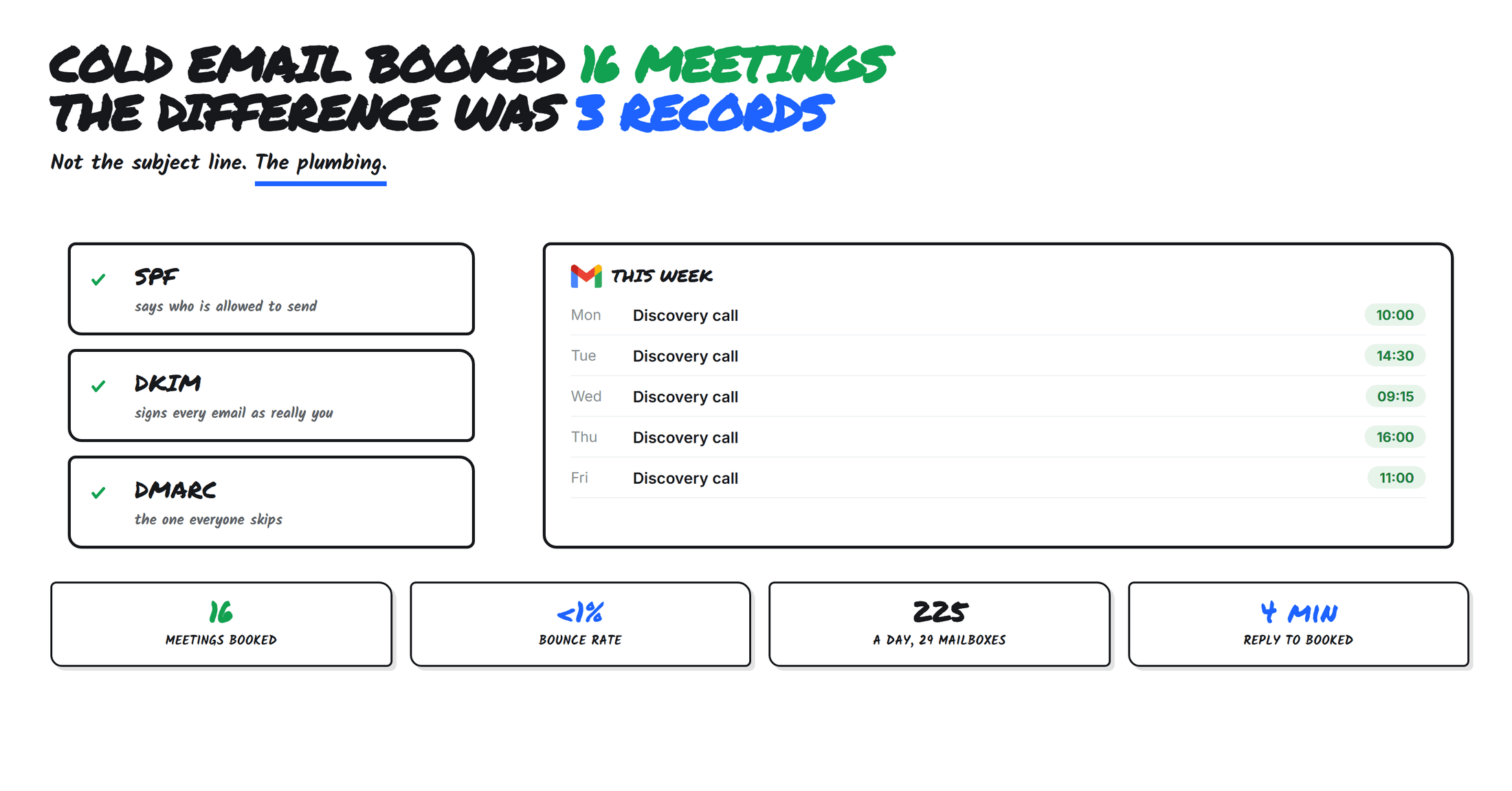
16 meetings booked last month. From the channel half your feed keeps calling dead.
I opened Instantly on a Tuesday morning and counted them off the calendar. Sixteen calls. Real stores, most spending north of $50k a month on Google Ads and stuck on why it wasn't scaling.
Not one of those sixteen came from a clever subject line.
That's the part people get backwards. They argue about copy because copy is the part you can see. Meanwhile the campaign is bleeding out one floor down, in the plumbing, and nobody looks there until the reply rate flatlines and the whole channel feels dead.
It wasn't dead. It was three DNS records and a list full of the wrong people.
So let me hand you the whole thing. The settings by name, the order we run it, and the mistakes that have cost other setups their domains. Nobody writes about this layer, because arguing about copy is easier than fixing pipes.
**The three records that decide whether you exist**
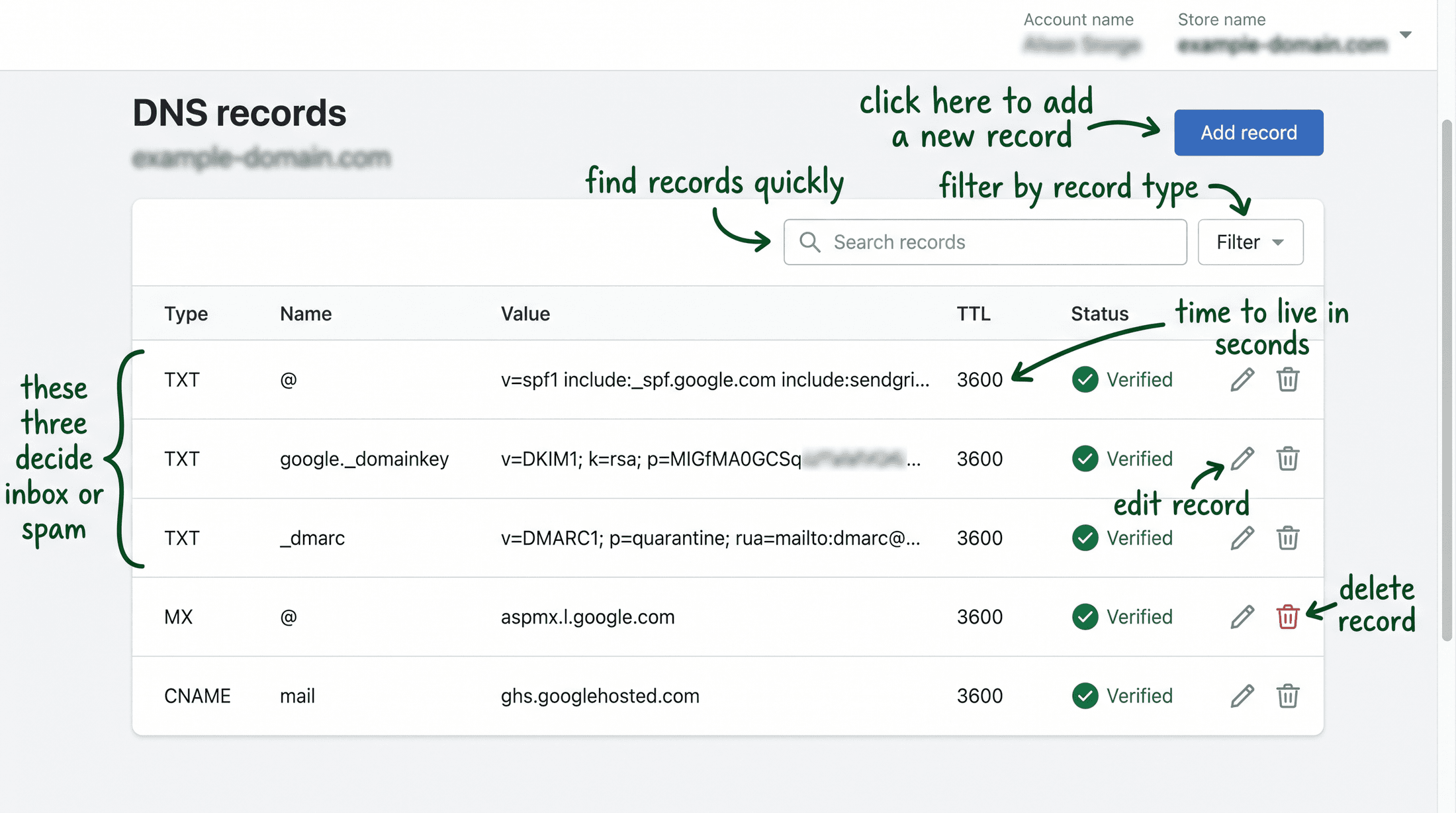
SPF, DKIM, DMARC. Three lines of text sitting in your DNS. They settle one question before a single word of your email gets read: does Gmail trust this message came from you, or does it drop you in spam and never tell you.
SPF is the guest list, the record naming which servers can send mail for your domain. Send through Google Workspace and it reads something like v=spf1 include:_spf.google.com ~all. The trap: it's capped at 10 DNS lookups. Stack your CRM and your warmup provider on top of your sending platform and it blows past the limit and fails without a word. You start landing in spam and never know why.
DKIM is the wax seal. Your sending server signs every message with a private key, and the matching public key sits in your DNS so the receiver can check the seal wasn't broken on the way over. Use a 2048-bit key, not the old 1024, which the providers now treat as weak.
DMARC is the one everyone skips, and the one Gmail and Outlook lean on hardest since the 2024 sender rules landed. It tells the receiver what to do when a message fails the other two, and it hands you reports on who's out there sending as you. Start it soft: v=DMARC1; p=none; rua=mailto:you@yourdomain.com. Watch the reports a couple of weeks, confirm your real mail passes, then tighten from none to quarantine. Most senders never publish it at all, then wonder why they live in promotions.
Five boring minutes per domain. That one habit is a big reason our bounces stay under 1% at 225 sends a day across 29 mailboxes.
[IMAGE-1: Google Postmaster Tools dashboard for a sending domain, domain reputation reading High, spam-rate line flat near 0%, and an authentication panel showing SPF, DKIM and DMARC all in a green pass column]
**Why we never send from the real domain**
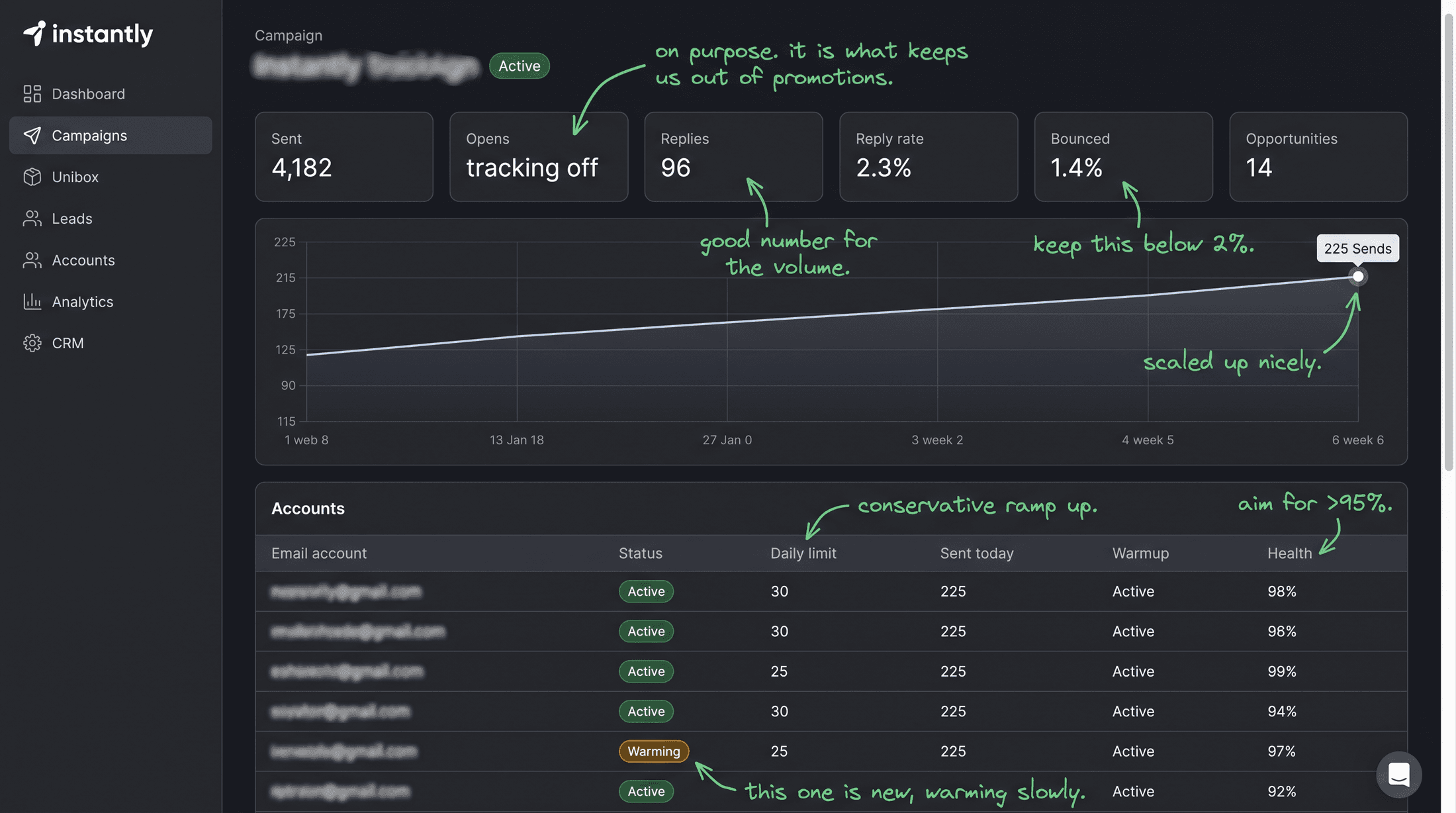
Here's the move that saves you when something goes wrong, and something always goes wrong.
You do not send cold email from your money domain. Not from the domain your website and your team's real inboxes live on. You buy secondary domains that look like you. If the brand is getbrand.com, you send from trygetbrand.com and getbrand-hq.com, and you 301 each one back to the main site so a curious prospect who types it in still lands on you.
Then you wait. A domain registered three days ago and blasting strangers is the loudest spam signal there is, so you age each one two to four weeks before it sends anything real. Set the MX records and stand up a basic page too, because a domain that can send but can't receive reads as fake. And put two or three mailboxes on a domain, no more. Cram ten onto one and you've stacked every egg in a basket that burns as a single unit.
The reason fits in one sentence. If a sending domain burns, your real domain never feels it. Your team's inboxes, your Google Workspace reputation, the invoices you send clients every day, none of it is on the line. Torch a throwaway, buy another. Torch your main domain and you've knocked out the email your whole company runs on.
[IMAGE-2: Instantly accounts view showing 8 sending domains and 29 connected mailboxes, a green warmup toggle on each row, health scores sitting in the 90s]
**The tracking domain nobody sets up, and the pixel you should kill**
This one is pure edge, because most people never touch it.
When your tool tracks opens and clicks, it wraps your links and drops a pixel, and by default it routes them through a shared tracking domain thousands of other senders use too. That shared domain is on every blocklist you can name, and you inherit its reputation the second you switch tracking on. So you set up your own custom tracking domain, a CNAME per sending domain, and now the tracking rides on your reputation instead of a burnt stranger's.
Better still, turn open tracking off. Gmail now reads that 1x1 pixel as a classic cold-outreach tell. You lose a vanity metric and gain inbox placement. We run tracking off. Open rate stops being a number I can see, and I stopped caring, because the number that pays rent is booked calls, not opens.
**Warmup, and the ramp that keeps you alive**
Warmup is the tool sitting in the background, sending friendly little emails between your mailboxes and a big network of others, replying to them, dragging them out of spam. To the provider it looks like a real person having real conversations, so it builds a track record before you send a stranger anything. Switch it on the day you connect a mailbox and leave it running, even mid-campaign, so the good behaviour never stops.
Give it two to three weeks before the first real send. Then ramp, and ramp slow.
→ Start around 20 to 30 real sends a day per mailbox, no more. → Add maybe 5 a day, watching the bounce rate the whole way up. → Cap it. We sit near 7 or 8 cold sends per mailbox, which is how 29 mailboxes gives a safe 225 a day. We ramped there from 115 over weeks. We didn't start there.
Get greedy here and you don't lose a campaign, you lose the domain. And not one domain, the whole set at once, because they're all sending the same bad pattern on the same day. Then you're buying new ones and waiting a month for them to age before you can send again. I've watched other setups burn months of runway to save two weeks.
[IMAGE-3: Instantly warmup dashboard, a deliverability line climbing from about 70% to 98% across three weeks, inbox-versus-spam placement bars mostly green]
**Targeting beats copy, and it isn't close**
Now the mistake that killed our first campaign.
It replied at 0.16%. Near enough to zero that I could have rewritten that email fifty times and moved nothing. The words were fine. The list was wrong. We were mailing people who were never going to care, whatever the first line said.
We fixed who we mailed, kept the exact same copy, and the reply rate tripled off the same words. That's the whole lesson. You're not writing a better email. You're writing to someone who fits.
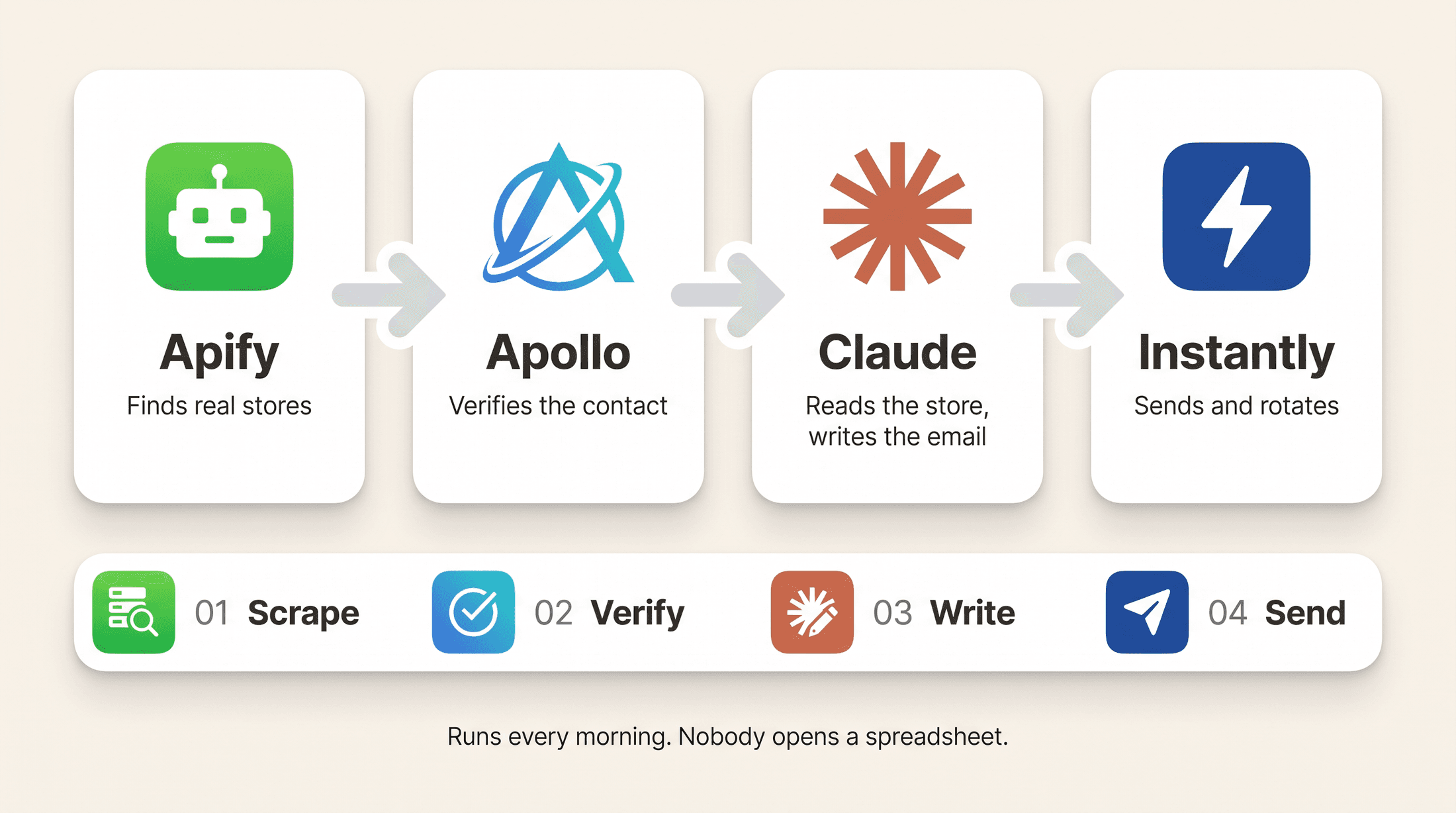
So the list gets built before the copy gets polished. Pull the ICP from Apollo or build it in Clay, then, and this is the step people skip, run every address through MillionVerifier or ZeroBounce before a single one loads. Apollo data goes stale, people leave jobs, inboxes die. One unverified list spikes your bounce past 2% and takes the domain with it. Segment the catch-all addresses onto their own track, treat them as a gamble, and never let a raw scrape touch a warmed domain.
**The email itself, stripped to what lands**
The copy still matters. It's the last thing, not the first.
Keep it plain. No images, no logos, no fat HTML signature, no header banner. One idea, 50 to 90 words, written like a human on a phone. One link at most, and zero is safer, because every link is a deliverability tax, worse when it's tracked. Use personalization tokens for first name and company, but set fallback defaults so you never fire a live Hi {{firstName}}, at a real person. Skip the words the filters hate, the free, the guarantee, the click here, the row of dollar signs. And send at human intervals, a random 60 to 180 seconds between messages, not one every 30 seconds on the clock like a machine.
[IMAGE-4: Instantly sequence editor showing a short plain-text first email beside a 3-step follow-up spaced 2 and 3 days apart, personalization tokens highlighted with their fallback values]
**The reply is not the win. The booked call is.**
This is where most meetings die, and nobody notices, because the reply landed and it felt like a win.
A warm reply that sits in an inbox for six hours is a cold lead by the time you open it. The person was ready at 9am. By 3pm they've moved on, or a competitor beat you to the calendar. So replies get triaged inside five minutes, sorted into interested, not now, wrong person, out of office, and the good ones go straight onto a Calendly link in the same reply. Speed to lead is the whole game on the back end.
And the follow-ups carry more than you'd think. Most replies don't come off email one, they come off three or four. Space them two to three days apart, and make each one a fresh angle, a different proof point. Never the lazy bumping this up your inbox, which tells the reader you've got nothing to add. On a dialed campaign the follow-ups book as many calls as email one does.
**Watch it like it owes you money**
None of this holds without a daily look. We verify each sending domain in Google Postmaster Tools, free, and almost nobody sets it up, and it reads the domain's reputation and spam rate straight from Google. Bounce rate gets checked every morning, and the second it climbs, that domain pauses. Once a week a seed test goes out through a tool like GlockApps, which lands in real Gmail and Outlook inboxes and tells you which folder you hit, because your own inbox is a liar, it always shows you the primary tab.
It all runs off a written checklist, same order every day, with a Slack ping when anything crosses a threshold, so a problem gets caught before breakfast instead of three weeks into a dead campaign. Write the system down once and you pay for the lesson a single time. After that the checklist carries it, and the same bad Monday never comes back.
**Your move this week**
Run cold outbound of any kind? Three things to check before Friday.
→ Open your DNS panel and confirm all three records exist. Not two. Three. If DMARC isn't there, that's your finding, and it's a five-minute fix.
→ Pull your real bounce rate, the raw number, not the rounded one on the dashboard. Anything creeping toward 2% is a domain in trouble and a list that needs a scrub.
→ Time how long your average reply sits before a human answers it. If you've never measured that, you already know it's too long.
Everyone wants to argue about the copy, because the copy is the fun part to argue about. The money leaks somewhere duller. Between the record you never set and the reply you answered six hours late.
Cold email isn't dead. Most people never built the part that makes it work.
So what's leaking in yours, the plumbing or the follow-up? Hit reply and tell me. I read every one.