The 8 tools that replaced 9 hires (and what each one costs)
Stephan Ochse ·

6:52 this morning. I was asleep. The company did a full day of work without me.
By the time I poured the coffee, the nightly audit had swept 107 Google Ads accounts, 223 checks on each one. The cold email system had booked two calls onto my calendar while I was out. Six client reports sat drafted in a folder, every number reconciled. And a product feed that broke at 2am, the kind that starves a Shopping campaign for a week, got caught, written up, and parked in a Slack thread waiting for one word from me.
Eight tools did all of that. Before 7am.
Here's the part that stops people. That whole payroll runs about $1,650 a month.
The same nine seats, filled with humans, cost north of $14,400 a month. And that's the raw wage bill, before anyone senior touches strategy, before someone quits in Q4 and you lose six weeks rehiring.
I run 100+ Google Ads accounts between $300k and $2.5M a month in spend off this. So the question I get most isn't the philosophy. It's the tools. What do you run all this on?
Here's the whole list. Every tool, what it costs, and the hire it replaced. Copy the shape. You don't need my exact tools.
[IMAGE-1: hyper-real Slack channel at 6:52am, a bot posting "Nightly audit complete, 107 accounts, 223 checks each" with two flagged threads below, "Spend spike, +$1.4k vs 7-day avg" and "Feed error, 183 items disapproved," green check reactions, real Slack UI]
→ Claude Code. The brain, and the biggest line on the bill at around $600 a month in usage.
This is the one everybody gets wrong, so read this part slow. People open Claude, type a question, read the answer, close it. That's the chat window. The chat window is the interview, not the employee.
The employee is a scheduled job. A plain doc that reads like instructions for a new hire on day one, step by step, this then this then this. A schedule that fires it at 3am with nobody watching. And a place for it to drop what it found when it's done. That doc is the job. The tool just reads it back and does it, every night, without me in the room.
Here's the secret that keeps the bill at $600 and not $6k. Model routing. The mechanical work, pulling the accounts, running the 223 checks, formatting the numbers, runs on the cheapest model. The one judgment call, the "is this spike a problem or a sale day" question, gets the expensive model for four sentences and then hands back. You run the whole job on the cheap engine and tap the smart one on the shoulder for the part that needs a brain. Miss this and your token bill reads like a second rent.
It builds the systems, runs the audits, drafts the reports, and wrote most of the software behind the rest of this list. I haven't typed a line of code and I stopped needing to. It replaced a developer, an analyst, and a real slice of my own week.
[IMAGE-2: hyper-real dark Claude Code terminal running a scheduled headless audit, an SOP checklist file open, Google Ads API pulls scrolling, a line reading "routing: haiku (pulls) then opus (1 judgment call)" and a cost line at the bottom reading "run cost: $0.42 across 107 accounts"]
→ Google Ads and GA4. The money side, and it costs me nothing to run.
That surprises people. The platforms are free. What you pay Google is the client's ad spend, not a tool bill. So the most important seat in the whole operation is a $0 line.
But it only earns its keep on one setting, the setting another agency will never point at, because it makes their reports look worse. Conversion time, never click time.
On click time, a sale that happens today gets dragged back and stapled to the click that earned it three weeks ago. On conversion time, it lands on the day the money came in. Read your account on click time and your brand campaigns start eating demand you were always going to get, people typing the store name into Google on their way to buy, and selling it back to you as a fresh win. The number looks like a hero. The bank disagrees. That one toggle is why our reports match reality and the last agency's didn't.
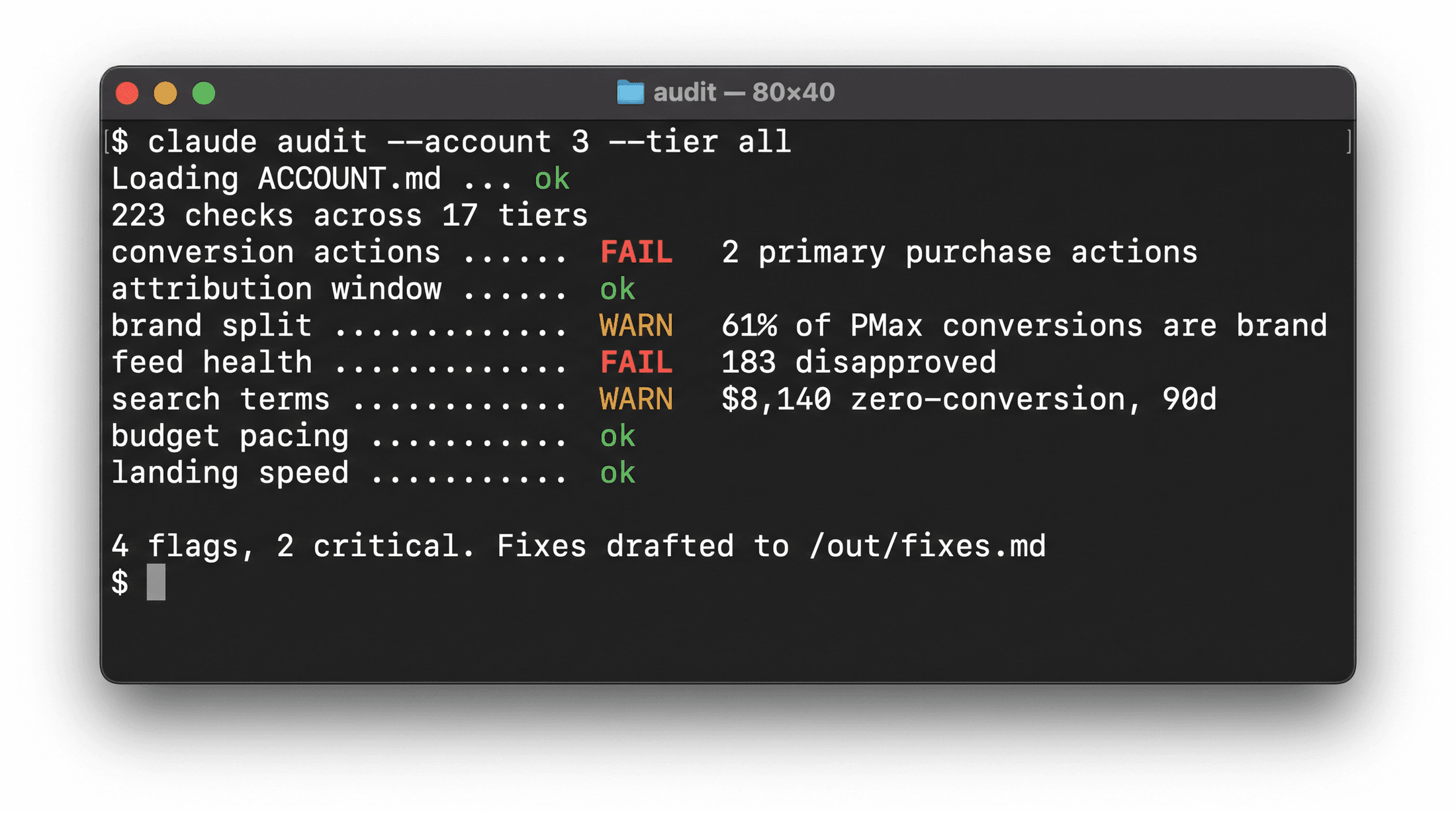
Every morning the agents run those 223 checks and price what they find in dollars, not a traffic-light dashboard nobody opens. "You're burning $6.1k a month here, in this exact place" beats a green checkmark every time.
[IMAGE-3: hyper-real Google Ads interface, the conversions segment switched to "conversion time," a performance table with the client name blurred, one column showing blended ROAS 4.2x and beside it brand-excluded ROAS 2.1x, the gap highlighted in red]
→ Slack. Where the software reports to me, around $15 a month in seats.
Every agent posts here. Audit findings at 7:04. Reports at 8:00. A flag the second a spend spike crosses the line, on a Tuesday, not buried in Friday's report when the money's already gone. My whole morning is reading messages from software and typing yes or no. It replaced the project manager whose job was chasing people for updates that this stack now posts on its own.
The trick with alerts is the threshold. An alert that fires on everything gets muted inside a week. Ours only pings when a number crosses a line that would cost real money. Silence means fine. A ping means look now.
→ Google Sheets. The least glamorous thing on this list, about $14 a month, and it does more than tools costing a hundred times that.
The checklists the agents run live here. The numbers a client can read without booking a call live here. It's the shared brain between me and the software. It replaced the coordinator whose master spreadsheet only they understood.
→ Shopify. The source of truth, and on a partner store it costs me nothing.
This is the number every ad platform gets checked against. Google Ads claims one thing, GA4 claims another, and they're both a little wrong on any given day. Shopify is the money that hit the account. When the dashboards and the store disagree, the store wins the argument. The bank statement doesn't care what the report said.
Here's the ten-second version of the check that saves accounts. Same day, three numbers side by side: GA4 purchases, Google Ads conversions, Shopify orders. More than 10% apart and your bidding is flying on bad fuel, and smart bidding will keep making worse calls with a straight face until you fix the signal.
[IMAGE-4: hyper-real single-day reconciliation view, three tiles side by side reading GA4 purchases 214, Google Ads conversions 231, Shopify orders 192, the Shopify tile circled and labeled "truth," a note reading "18% drift = broken tag"]
→ Instantly. The pipeline, around $350 a month once you count the inboxes.
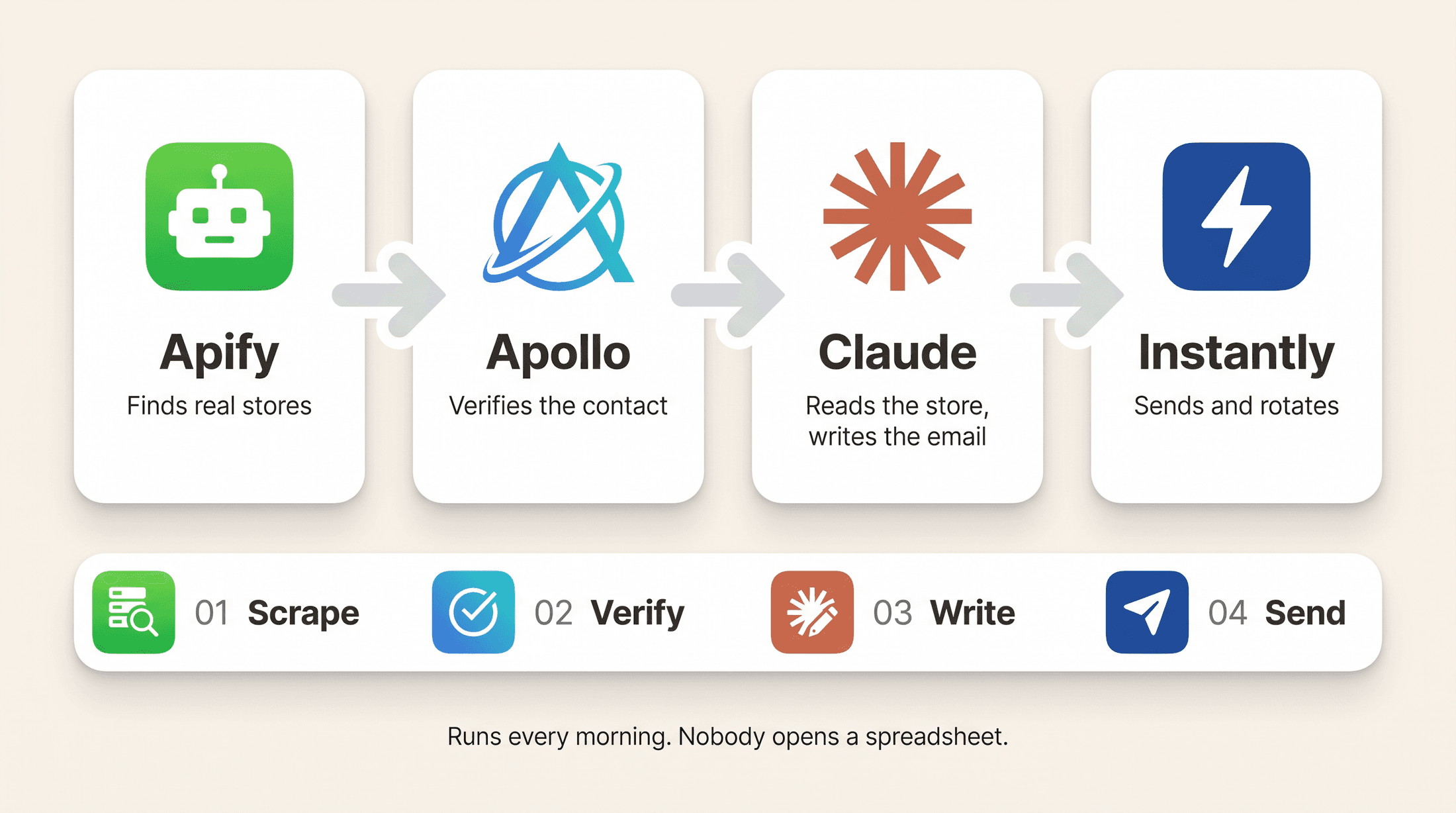
Verified addresses, so you're not burning a domain on bounces. A real first line for each person, not a mail-merge that screams robot. Sending capped and ramped so the inboxes stay alive. 16 booked meetings last month, and I chased none of them.
The reason most cold email dies is people run it from one domain, blast 400 a day out of the gate, and get flagged as spam inside a week. The shape that works is boring: several sending domains, a handful of mailboxes on each, warmed for weeks before a single real send, ramping the volume up slow. It replaced an SDR at $3,200 a month, and the SDR needed weekends off.
→ Supabase and Vercel. The publishing engine, about $45 a month together.
They run the machine that drafts the content and schedules it out. An agent writes the post, it gets stored, the calendar fires it, and I approve from my phone in the back of a taxi. Database plus hosting for the price of two lunches. It replaced a content team, or the version of me that used to lose a Sunday writing captions.
→ Image and video generation. The creative desk, around $150 a month in credits.
One product photo goes in. Twelve ad variants come out. YouTube cuts and Demand Gen images ride along in the same batch. A production designer on retainer used to need a week for one round. Now it's an afternoon and a credit balance. It replaced the retainer.
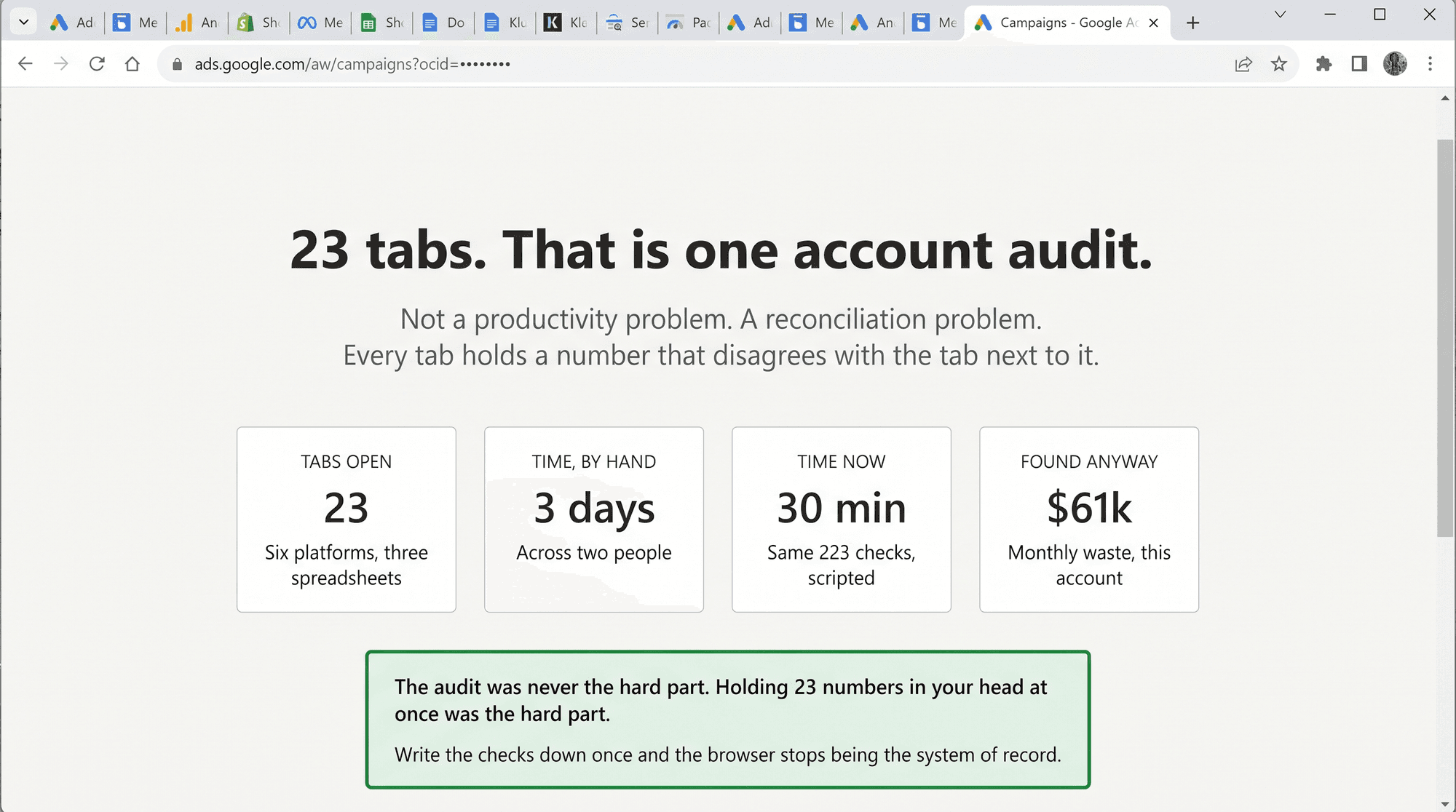
So add it up. About $600 for the brain, $350 for the inboxes, $150 for creative, and a long tail of $45, $15, $14, and a few clean zeroes. About $1,650 a month against $14,400 in salaries.
Two lines carry almost the whole cost, the tokens and the inboxes. The rest of the stack, the reporting and the truth-checking and the coordinating, is close to free. The seats that cost the most in a normal agency are the cheap ones here.
But the gap in dollars isn't even the real reason it works. Stop at the money and you'll build the wrong thing.
It works at 3am. It works on a bank holiday, in the dead week between Christmas and New Year when every human agency is out of office. It serves client 25 for almost the same effort as client 5, because adding an account to a nightly job is a line in a config, not a new hire. And it gets sharper every month instead of duller, because a checklist compounds and a tired person on their fourth report of the day forgets a row.
Then there's the part I never handed to any of it, and never will.
Budget calls. Client conversations. Who to hire. Every decision where the answer isn't already sitting in a spreadsheet. The agents pull, check, draft and catch, and then they stop. Every flag shows up as a proposal with the fix already written, and it sits there until I say yes or no. Turning a budget up, pausing a campaign, moving spend, that gets a human every single time. I didn't automate the judgment. I automated everything that was never judgment and had only ever squatted on my calendar wearing a costume that looked like work.
So if you're starting from zero, the one move is the opposite of what you want to do.
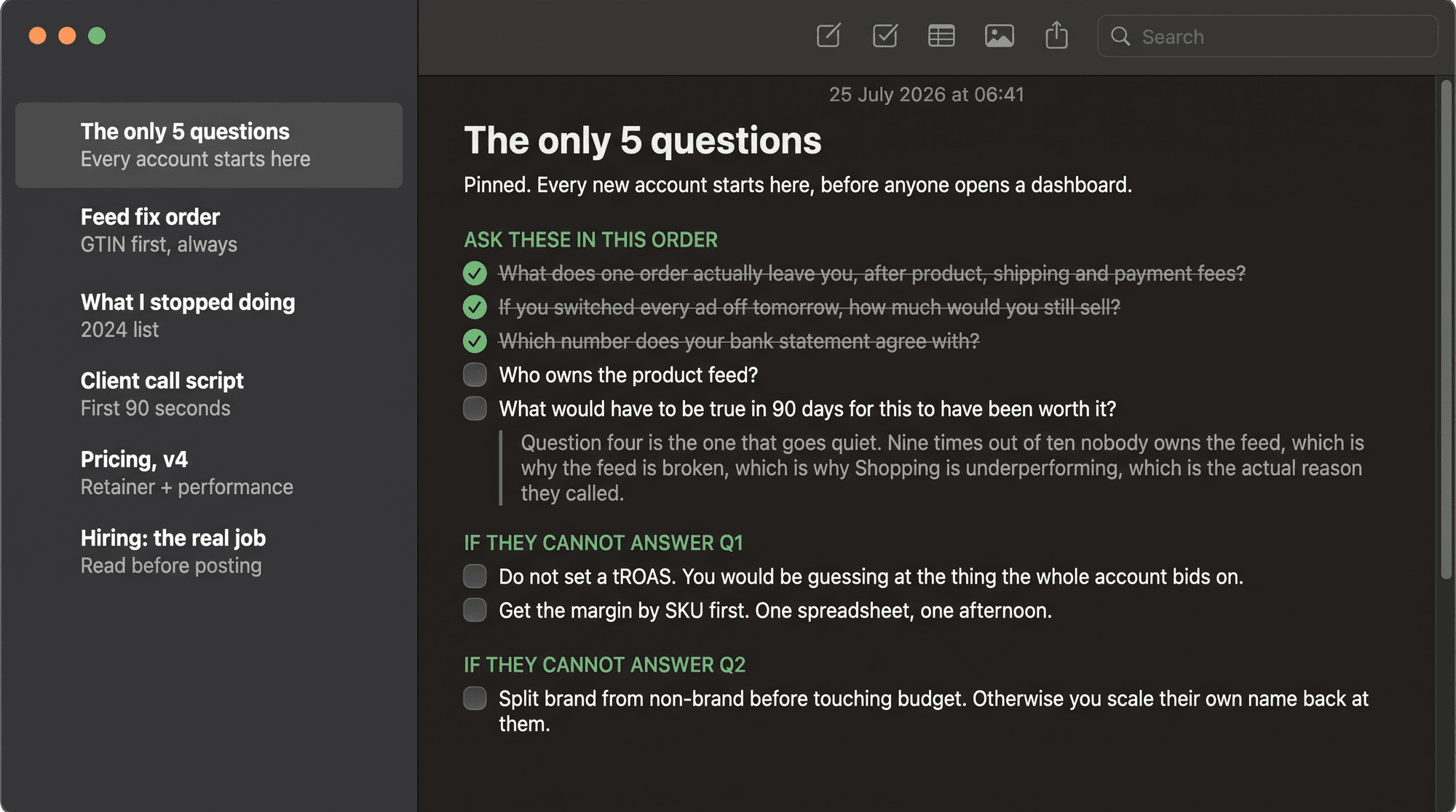
Don't copy the list. That's the trap. You'll try to stand up all eight at once, lose a month wiring things that don't talk to each other, and quit before a single one earns its keep.
Pick one. The single task you repeat every week that only ever ate your hours and never your judgment. The report. The follow-up. Write it out like you're handing it to a new assistant on day one, every step, every trigger. Put one tool on that one doc. Run it for a month, until you trust it more than you trust yourself half asleep. Then, and only then, add the next.
Time yourself doing it by hand once first. That's your before. Next week it runs without you, and you'll feel exactly what you bought back.
This stack took two years to build. The first tool took an afternoon.
[IMAGE-5: hyper-real cost dashboard, two columns side by side, the left titled "The stack" listing 8 tools with monthly dollar chips summing to $1,650, the right titled "The payroll" listing 9 greyed-out human roles summing to $14,400, a bold figure at the bottom reading "-$12,750 / mo"]
The whole thing didn't replace me. It replaced the version of me that spent the day doing what a checklist could do. That version was never the operator. It was the intern I couldn't stop being.
So which hire does your first tool replace? Hit reply and tell me. I read every one.